
What we talk about when we talk about The Case for Marrying an Older Man
Let's define our terms a bit

Last week, everyone went wild for The Cut essay “The Case for Marrying an Older Man,” by Grazie Sophia Christie. Its reception was a bit retro, bringing us back to the mid-2010s heyday of viral internet pieces. “The personal essay is back!” some declared. There were reminiscences about Gawker, Thought Catalog, and, of course, XOJane.
As with the tell-all essays featured in those publications, Christie’s essay was largely received as a hateread. For a day or two, the author became Twitter’s Main Character, and people (myself included) speculated how long her marriage might last. We made fun of the phrase “high breasts.”


Jokes aside, I think the essay and the reactions it provoked offer a great case study in a common problem. When people these days criticize a piece of art, they conflate a lot of different things: the art itself, the explicit or implied viewpoint, and the life of the creator. (They also, often, criticize the author’s real or perceived fanbase, a topic which I will not be covering here). There is the increasingly common view that art is prescriptive, and that depiction equals endorsement. As Lincoln Michel writes, many contemporary readers struggle to tell these things apart when presented with a sci-fi short story. What are they to do when they encounter the personal essay, a form whose very nature is predicated on its author’s life and perceptions?
I think it is worth trying to break apart these different modes of critique. Not for the sake of “The Case for Marrying an Older Man,” but for the sake of the reading public in general. Perhaps this is a selfish endeavor, as I have my own book of personal essays coming out next year.
First, there is the question of: is “The Case for Marrying an Older Man” good from an artistic perspective? The way I always approach this question is, did I enjoy it? And the answer is, I mostly did. I found the premise to be intriguing, Edith Whartonish, and I read it to the end. There were some nice turns of phrase, though also some head-scratchers: the aforementioned “high breasts,” “play, rather badly, the lotto,” and the likening of aging — a permanent condition — to “a looming eclipse” (a temporary, short-lived phenomenon). I’m reminded of a short story I wrote in high school called “The Indelible Storm.” Storms can’t be indelible!
Mostly, though, the essay succeeded as a character study. I think this is the part of personal essays that really confuses people. When you read a personal essay, I recommend viewing the author as a kind of fictional character offering a first-person view of how they see the world. The author is not necessarily holding themselves up as a model of good behavior (see: this recent Emily Gold essay). In fact, I think the best personal essays show the author in an unflattering light — in the same way that the best fictional protagonists are at least a little unlikeable.
This makes personal essays very different from other types of first-person nonfiction, like the op-ed. With op-eds, the author is clearly advocating for a specific position to you, the reader. They are not merely describing things from their vantage point. They are saying, basically, “THIS IS GOOD” and “THIS IS BAD.” A similar purpose is served by the self-help book or the advice column. (there is also, of course, the genre of criticism — such as this essay you are reading now — which tries to examine a piece of work, art, trend, or object from different viewpoints without necessarily offering a strong verdict)
Christie does, at times, offer advice. “As far as life decisions go, on balance, I recommend it,” she says of her decision to marry a rich guy. But fictional characters, too, dispense advice, and following it is not necessarily a good idea. Also worth noting is the fact that “The Case for Marrying an Older Man” is part of a series commissioned by The Cut for “tak[ing] life off ‘hard mode.’” This context might indicate that the essay was intended to be taken at face value. But The Cut is also famous for its personal essays (and most of the essay is written in the style of a personal essay), so I am going to assume that this is the category of writing “The Case for Marrying an Older Man” falls into.
Which brings me to the question of, what is the author’s explicit or implied viewpoint? And do I agree? Christie is arguing that it behooves young women to consider — instead of equal partnership in a household with two breadwinners — becoming the kept woman of an older, wealthy man. As Thomas Piketty has written, marrying for money makes increasing economic sense in this time of expanding inequality and a tattered welfare state.
And, if you have any kind of creative ambitions, this is extra, extra true. Developing a craft and a body of work requires an enormous amount of uninterrupted time, which is why most people are not able to do pursue careers in the arts (they have to spend their time at jobs). Christie writes candidly about how her marriage allows her the time to develop the craft of writing, and to write for far below minimum wage, “without having to live like a writer.” I have met plenty of writers with similar arrangements, as well as writers who do sex work, which allows them the same kind of time and money tradeoff.
Christie is even honest about the downsides of her marriage. “I live in an apartment whose rent he pays and that shapes the freedom with which I can ever be angry with him,” she tells us.
But being a woman with a lucrative career has its downsides, too. Even if you’re in finance or tech or a white shoe law firm, you are there conditionally, meaning you can’t tell your boss to go fuck themselves. In some ways your life is not so different from Christie’s, except that you probably don’t have as much free time to pitch essays to The Cut.
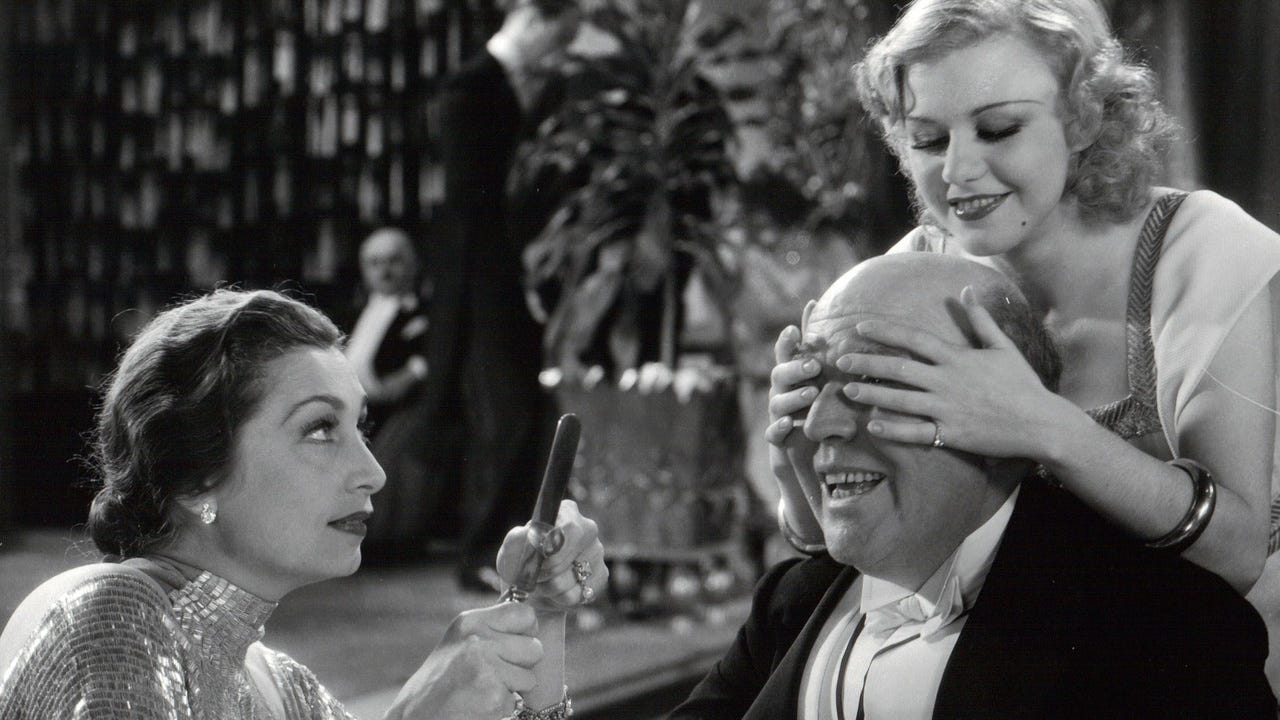
“I had grown bored of discussions of fair and unfair, equal or unequal, and preferred instead to consider a thing called ease,” she says. It is a dose of sexual realpolitik in a time when it appears that no policy changes will be coming to improve things. It reminds me of the attitude depicted in Gold Diggers of 1933 — a pre-code musical made during the Great Depression — in which three showgirls hoodwink three rich guys into marrying them.
I think what really bothered people about this essay was the author’s emphasis on the market value of youth. Female youth is valued highly and can be exchanged, in various ways, for money. Of course, what constitutes youth is I think a bit broader than what the author argues. At least based on personal experience, your breasts can still be quite high into your thirties. But again, it’s the realpolitik thing that I think people hated and I actually liked. We live in an unfair society. Even though we know how to make things fair, they don’t look to be changing any time soon. What can you, personally, do about it? Her answer: Study in the Harvard Business School library.
Christie seems — like the showgirls in Gold Diggers — to have exchanged her youthful beauty for long-term financial security. But has she really? She’s been married four years. But she’s just 27, and so — despite her belief that her best years are behind her — she has not yet started to show real signs of aging. She also hasn’t had kids yet, though she tells us she and her husband want to start trying soon. Aging, parenting, health issues: These are the real tests of a marriage. Given the premise of their relationship, how can Christie be so sure that in ten or fifteen years her husband won’t just run off with another high-breasted college student?
All this being said, is her essay — taken as advice — good advice that you, the reader should take? If you seek to live luxuriously while beginning a writing career, maybe. If you seek to have a lifelong marriage and/or a marriage where you feel equal to your husband, I’m not so sure.
Which brings me to my final mode of assessment. Did Christie make a “good” choice in her life? I don’t know. I know very little about her besides what she wrote in her essay, plus the results of a cursory Google search. It’s basically none of my business, though I do hope her marriage works out.
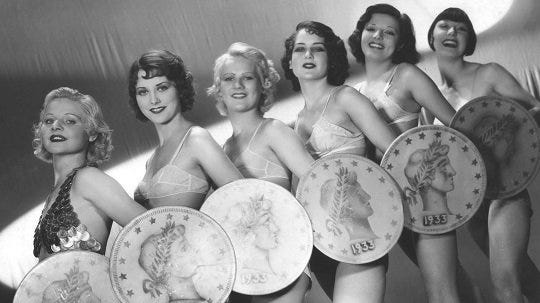
Now, I am going to transition from critique to prescription. I recommend that you watch Gold Diggers of 1933. It’s a lot more fun.